Through our recruitment work at Teach East, we have seen a clear pattern emerge across international schools. Experience with school inspections is increasingly viewed as a key indicator of leadership capability and teaching quality. This applies across multiple regions, including the UAE, Saudi Arabia, the Far East, and the UK. Schools are placing greater emphasis on hiring educators who understand inspection frameworks and can demonstrate their impact on school improvement.
Teachers considering an international career also need to be aware that inspection processes differ depending on the region, curriculum, type of school, and other factors. Even if they are not in a leadership role, having an understanding of inspection expectations is important, as inspections involve the entire school community, from leaders and teachers to students.
This article explores how inspections operate globally, what they mean for educators, and how awareness of these processes supports professional growth.
Why inspections matter for teachers
Inspections drive accountability and continuous improvement. For teachers, they directly influence several areas of professional life.
Inspectors evaluate lesson planning, classroom practice, differentiation, and assessment. Consistency and evidence of effective pedagogy are central to every evaluation.
Professional development:
In our tracking of teacher mobility and recruitment, educators who demonstrate measurable improvement in inspection outcomes often progress faster into leadership or specialist roles. Constructive inspection feedback provides a clear roadmap for professional growth and classroom improvement.
During inspection cycles, workload tends to intensify as lesson observations, evidence preparation, and documentation reviews become more frequent. Teachers who anticipate this can better balance preparation with day-to-day teaching.
Job security and reputation:
Inspection results often influence a school’s public image and, in some markets, can impact teacher retention or promotion prospects.
Ultimately, inspections focus on learning impact. Effective teaching and consistent student progress remain at the heart of any evaluation framework.
Understanding the inspection landscape in the region where you teach helps reduce uncertainty and enables focus on quality teaching rather than last-minute compliance.
Types of school inspections
Comprehensive inspections:
Full reviews covering leadership, curriculum, teaching, outcomes, and wellbeing. Inspectors observe lessons, review evidence, and produce detailed reports.
These focus on specific aspects such as safeguarding, inclusion, or curriculum implementation, often triggered by data or policy priorities. Though narrower in scope, they remain key to quality assurance.
Risk-based monitoring or follow-up inspections:
Used for schools previously rated at risk or underperforming. These involve repeated visits and progress tracking rather than full re-evaluation.
Diagnostic or developmental reviews:
Formative visits focused on improvement rather than judgement. Inspectors provide practical guidance and actionable feedback.
Self-evaluation with external support:
Many countries now combine internal review with external oversight. Teachers often contribute to evidence gathering and reflection reports, supporting a culture of ongoing improvement.
Accreditation and third-party reviews:
International schools frequently undergo external accreditation from organisations such as CIS or WASC, blending local regulatory compliance with international benchmarks.
The UAE maintains a structured and transparent inspection framework. In Dubai, the KHDA oversees private schools, while in Abu Dhabi, ADEK manages both private and public sectors.
While the system is gradually transitioning towards targeted and self-evaluation models for 2025–26, full inspections remain in place for many schools, particularly those on follow-up or risk-based schedules.
Implications for teachers
Being aware of both traditional and emerging inspection models is beneficial. Teachers benefit from maintaining records of student progress, engaging with internal review processes, and contributing to school self-evaluation initiatives, supporting readiness throughout the year.
Saudi Arabia’s Education and Training Evaluation Commission drives a nationwide inspection and evaluation system aligned with Vision 2030 reforms.
Schools complete both self-evaluation and external evaluation, with inspections focused on teaching quality, leadership, and student outcomes.
Implications for teachers
Regular visits and feedback cycles encourage continuous professional reflection. Teachers who engage proactively with development opportunities and document their progress find this system highly supportive of growth.
Ofsted regulates inspections for maintained, academy, and independent schools in England under the Education Inspection Framework.
Recent updates (effective November 2025)
The framework introduces a five-point grading scale with safeguarding assessed separately. There is greater emphasis on curriculum intent, implementation, and impact, shifting focus from pure outcomes to teaching quality. Thematic and subject-focused reviews will also expand across the system.
Implications for teachers
Lesson delivery, curriculum design, and assessment rationale remain focal points. Understanding the revised framework and aligning teaching evidence to curriculum intent ensures confidence and professional credibility during inspections. Targeted inspections, while narrower in scope, continue to support overall quality assurance and policy monitoring.
School inspections in China vary by province, guided by local education bureaus under the Ministry of Education. Many international schools operate within both local and international accreditation systems.
Teachers often balance dual expectations, national curriculum alignment, and international standards.
Implications for teachers
China’s inspection landscape is complex and ever-changing. Teachers benefit from adaptability, maintaining documentation that demonstrates alignment across frameworks while leveraging feedback for ongoing professional growth.
Scandinavian education systems take a distinct stance on inspection. Trust and professionalism form the foundation of school evaluation. Instead of regular external visits, schools conduct internal quality reviews, focusing on collaboration, peer feedback, and long-term improvement. External reviews occur occasionally to support rather than assess performance, reinforcing a culture of autonomy and shared responsibility.
- Movement from annual full inspections to targeted or hybrid models
- Greater use of data dashboards, self-evaluation documents, and performance analytics
- Integration of inspections with national reform initiatives
- Emphasis on curriculum quality and teaching impact over numeric grades
- International schools operating under dual regulatory frameworks
- Increasingly comprehensive frameworks can make cross-region comparison less straightforward
Practical guidance for teachers
- Familiarise yourself with your region’s inspection framework, priorities, and reporting cycle
- Maintain organised records, including lesson plans, student progress, classroom management, documentation, and professional development
- Contribute actively to self-evaluation and internal review discussions
- Align classroom practice with school-wide improvement goals
- Use inspection feedback as a tool for reflection and professional growth
Inspection readiness is less about perfection and more about consistency, reflection, and professional awareness. When teachers stay organised and engaged throughout the year, the process becomes far more manageable and often professionally rewarding.
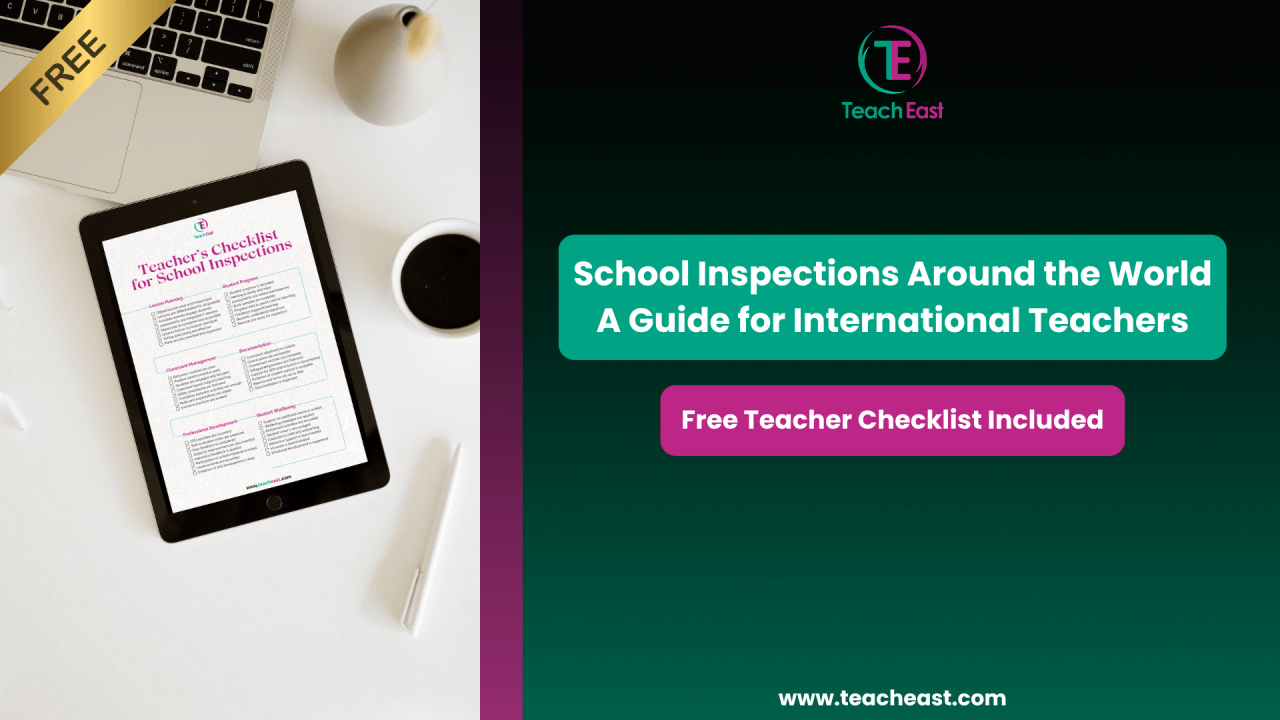
To help educators stay confident and structured, we have created a free School Inspection Checklist. It covers key areas including lesson planning, assessment evidence, classroom environment, professional development, and wellbeing indicators.
Download the checklist and take a proactive step towards inspection confidence and continuous improvement.


0 Comments