
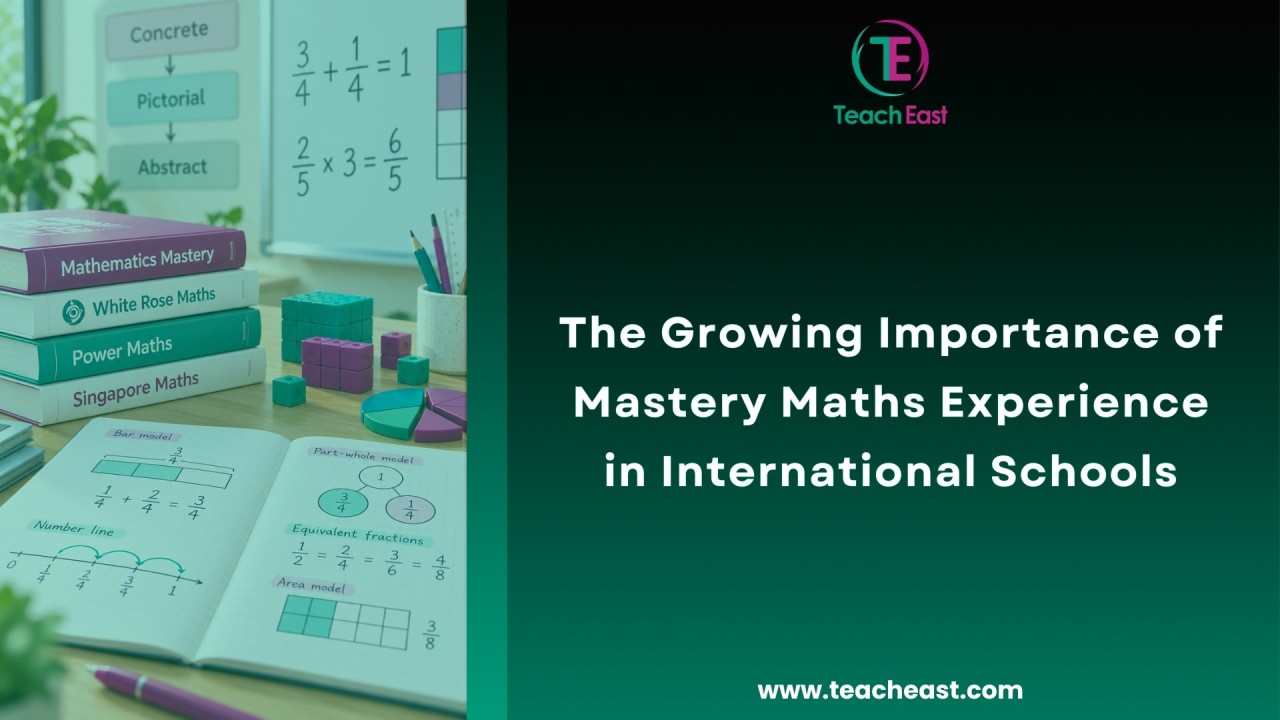
The language of small steps, mathematical reasoning, variation, representation and depth has become increasingly familiar across schools, alongside programmes such as White Rose Maths, Power Maths and Singapore Maths.
What is changing, however, is the scale of the conversation. As more schools adopt mastery-based approaches and international schools add established mastery resources to their curricula, familiarity with the principles behind them is becoming increasingly valuable. Knowing how to work through a scheme is one thing; understanding how to make it work in a classroom is another.
So, how established is mastery maths today? What does the evidence tell us about its impact? And as the approach continues to spread, what does that mean for mathematics teaching in international schools?
The Expansion of Mastery Maths
Shanghai has also influenced mathematics education internationally, particularly through its approach to mathematical reasoning, depth of understanding and the use of carefully structured lesson sequences. Together with developments in other high-performing education systems, these approaches have contributed to the wider international conversation around how mathematics can be taught for deeper understanding rather than simply covering more content.
Today, mastery maths can be found in a wide range of international schools, although it does not look identical everywhere. Some schools use established programmes such as White Rose Maths or Power Maths, while others draw on Singapore Maths or incorporate mastery principles into their own curriculum.
The reach of these resources reflects how international the approach has become. White Rose Maths reports that its resources are used by more than 18,000 schools across more than 100 countries, while Power Maths is also marketed to international schools following a British curriculum.
The result is a much broader mastery landscape than there was a few decades ago. The curriculum, programme and terminology may differ from one school to another, but the underlying principles remain familiar: carefully sequenced learning, mathematical reasoning, purposeful representations, fluency and giving pupils the depth of understanding needed to make meaningful connections between mathematical ideas.
A Growing Mastery Landscape
White Rose Maths is one of the most widely recognised mastery programmes in England and has developed a substantial international reach. Power Maths, developed by Pearson in collaboration with White Rose Maths, takes a similar whole-class mastery approach and is also used internationally. Singapore Maths remains another major influence, particularly through its emphasis on problem solving and the concrete–pictorial–abstract approach.
The programmes are not interchangeable, and schools do not necessarily follow every principle in exactly the same way. What connects them is a focus on building secure understanding, making mathematical connections and developing reasoning alongside fluency.
Does Mastery Maths Make a Difference?
The evidence so far is encouraging, although it needs to be considered carefully. The Education Endowment Foundation has evaluated Mathematics Mastery through separate trials at primary and secondary level. In the primary trial, involving more than 5,000 pupils across 90 schools, pupils using Mathematics Mastery made around two months’ additional progress compared with pupils in the comparison group. A separate secondary trial, involving more than 7,700 pupils across 40 schools, found around one month’s additional progress.
These results relate to specific Mathematics Mastery programmes, rather than proving that every implementation of mastery maths will produce the same outcomes. The EEF describes the evidence as promising rather than conclusive.
The wider principles behind mastery, including mathematical representations, structured progression, reasoning, mathematical language and deliberate practice are supported by a broader body of educational research. But putting those principles into practice effectively still depends on how they are implemented in the classroom.
What Mastery Experience Looks Like in the Classroom
Mastery teaching requires teachers to recognise misconceptions as they emerge, select representations that make mathematical ideas clearer, ask questions that reveal pupils’ thinking and judge when a class is ready to move forward. It also means knowing when to spend longer on an idea rather than moving on simply because the scheme says it is time for the next lesson.
The same applies to challenge. In a mastery classroom, supporting a pupil who is struggling does not necessarily mean giving them easier mathematics, just as challenging a confident pupil does not always mean moving them on to the next year group. Both can work with the same mathematical concept while exploring it at different levels of depth and complexity.
Over time, teachers develop a practical understanding of which representations clarify a concept, which misconceptions are likely to appear and which questions can move pupils beyond simply finding an answer towards explaining their mathematical thinking.
Those skills are transferable across programmes and curricula. A teacher may move from White Rose Maths to Singapore Maths, or into a school using its own mastery-based scheme, but the underlying classroom knowledge remains relevant.
Where Does Mastery Maths Go From Here?
For schools, the focus is increasingly on implementation: how mastery principles fit within the wider curriculum, how teachers are supported and how pupils are given the time and structure needed to develop genuine mathematical understanding.
For teachers, this creates a professional skill set that can travel between schools and curricula. Experience with mathematical reasoning, representations, misconceptions and teaching for depth remains relevant even when the programme itself changes.
As mastery continues to evolve internationally, the ability to turn those principles into effective classroom practice will remain an important part of mathematics teaching.
Looking for your next international maths teaching opportunity?
If you have experience teaching mathematics through a mastery approach, your skills can transfer across a range of international school settings and curricula. Whether your experience is with White Rose Maths, Power Maths, Singapore Maths or another mastery-based programme, there are schools looking for teachers who can turn those principles into effective classroom practice.
Explore current international mathematics teaching vacancies with TeachEast and discover where your experience could take you next.

0 Comments