By Lubna Muhammad Zahid Recruitment Consultant at Teach East Working closely with schools and education partners across the United Arab Emirates
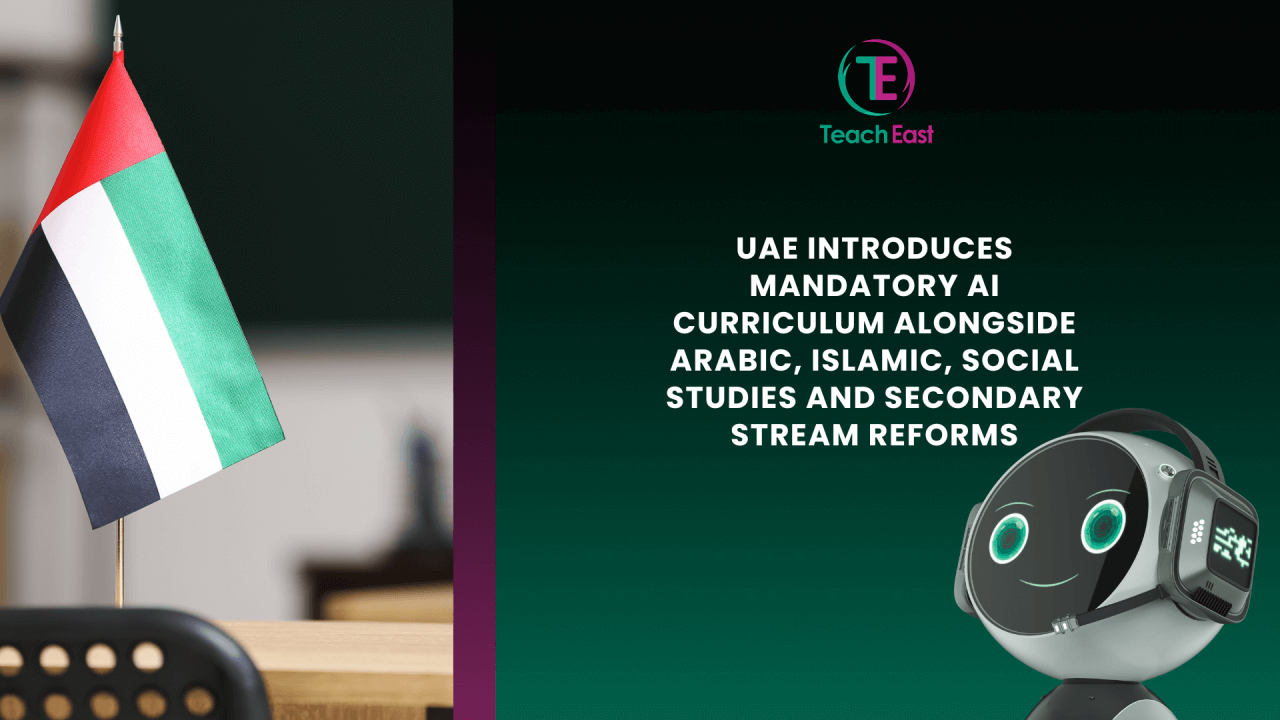
The United Arab Emirates Ministry of Education has announced sweeping updates to the national curriculum, including the introduction of Artificial Intelligence (AI) as a compulsory subject from Kindergarten through Grade 12. These changes will be implemented beginning the 2025–2026 academic year and will apply across public schools and private schools following the Ministry’s curriculum.
The announcement was made recently by His Highness Sheikh Mohammed bin Rashid Al Maktoum, Vice President, Prime Minister of the UAE and Ruler of Dubai, as part of the nation’s vision to equip its students with skills necessary for the future economy while simultaneously reinforcing cultural and ethical foundations through enhanced Arabic, Islamic, and Social Studies.
Overview of the Curriculum Reforms
The Ministry’s curriculum overhaul reflects the UAE’s strategic intent to balance technological innovation with preserving national identity. While the addition of AI education prepares students for a rapidly evolving digital economy, the reforms also strengthen instruction in core subjects that embody the UAE’s cultural heritage and societal values.
These changes have been informed by comprehensive field research, including input from educators, parents, and higher education institutions, ensuring the reforms are responsive to evolving educational needs.
What Does the AI Curriculum Include?
Artificial Intelligence will become a mandatory subject for all students from Kindergarten through Grade 12 in schools that follow the Ministry’s curriculum. The curriculum is designed to:
- Introduce students to foundational concepts such as data literacy, algorithms, and machine learning
- Provide practical understanding of AI applications in daily life and industry
- Develop critical awareness of ethical issues surrounding AI, including data privacy, algorithmic bias, and responsible use
The Ministry has clarified that AI education will be integrated within existing subjects such as Computing and Creative Design and Innovation and will not require extending the official school day.
The curriculum also emphasises teacher training programmes and digital learning platforms to ensure educators are equipped to deliver the content effectively.
Why AI Education Is a National Priority
During the announcement, His Highness Sheikh Mohammed bin Rashid Al Maktoum stated:
“Our goal is to teach our children a deep understanding of AI from a technical perspective, while also fostering their awareness of the ethics of this new technology… Our responsibility is to equip our children for a time unlike ours, with conditions different from ours, and with new skills and capabilities that ensure the continued development and progress in our nation for decades to come.”
Supporting this vision, Her Excellency Sarah bint Youssef Al Amiri, Minister of Education of the United Arab Emirates, shared her reflections in the Ministry’s publication Reflections on AI in Education:
“In the UAE, adopting and advancing AI is not optional; it is essential to our national future. AI supports economic growth, fosters sustainable development, and significantly enhances individual capabilities. However, the integration of AI in education must be purposeful and underpinned by a strong foundation of AI literacy for students, teachers, and parents alike.”
She emphasised the need for students to learn not only how to use AI but also to understand its limitations, biases, and ethical implications, ensuring AI becomes a tool to augment human capabilities, rather than replace them.
Enhancements to Arabic, Islamic, and Social Studies
Alongside the introduction of AI, the Ministry has reinforced the importance of Arabic, Islamic, and Social Studies to foster a strong sense of national identity and cultural continuity from an early age.
Key updates include:
- Arabic Language: Kindergarten students will receive a minimum of 200 minutes per week of Arabic instruction. This aims to develop early literacy skills and deepen students’ connection to the Arabic language and UAE culture.
- Islamic Studies: Muslim students in Kindergarten will have 90 minutes per week of Islamic instruction, focusing on spiritual growth, key values, and religious knowledge.
- Social Studies: Delivered through play-based, interactive methods, this subject introduces young learners to concepts such as family, community, geography of the UAE, environmental stewardship, and national values.
These reforms ensure that as students gain technical skills for the future, they also develop a well-rounded understanding of their heritage and social responsibilities.
Updates to Secondary School Streams
In addition to curriculum content, the Ministry has redesigned the educational streams for Cycle 3 students (Grades 9 to 12), effective from the 2025–2026 academic year. This applies to all public schools and private schools following the national curriculum.
The Ministry explained:
“The Ministry has redesigned the educational streams to align with students’ future aspirations, support their higher education journeys, and enhance their ability to keep pace with the evolving labour market.”
What are the new streams?
- Advanced Stream: Focused on more in-depth scientific subjects such as Physics, Chemistry, Biology, and Advanced Mathematics, the advanced stream prepares students for university degrees in fields including Engineering, Medicine, Pharmacy, and Science.
- General Stream: This stream covers subjects in the Humanities, Business Administration, Law, Arts, and Social Sciences.
Students are expected to select their stream by Grade 8, guided by school counsellors and supported by comprehensive guidance manuals issued by the Ministry. This structured approach assists students and families in making informed decisions aligned with university admission requirements and career aspirations.
Implementation and Support for Schools
Successfully introducing these reforms requires substantial support for schools and educators. The Ministry has planned:
- Teacher training programmes focusing on AI literacy and new pedagogical methods for all subjects affected
- Development of digital learning platforms and resources to assist both teachers and students
- Engagement with parents and communities to explain curriculum changes and support student choices
- Alignment with Higher Education Institutions (HEIs) across the UAE to ensure a seamless transition from secondary education to university
At Teach East, we are actively partnering with schools to support recruitment and training efforts that will enable effective delivery of these reforms.
Conclusion
-
The UAE’s updated curriculum represents a comprehensive and thoughtful approach to education reform. By mandating AI education alongside strengthened Arabic, Islamic, and Social Studies, the nation is preparing its students to thrive in a technology-driven global economy while remaining firmly rooted in their cultural and ethical heritage.
As Her Excellency Sarah bint Youssef Al Amiri emphasised:
“AI is a tool to enhance education, but human values, judgement, and ethics must remain at the core of our learning systems.”
At Teach East, we are committed to supporting the UAE’s education sector through this transition, helping schools recruit forward-thinking educators who will prepare students for success in this new era.
About the Author
Lubna Muhammad Zahid Recruitment Consultant at Teach East Supporting schools and education partners across the UAE with strategic recruitment and talent development.

0 Comments